Core Insights!
- CPM in Advertising is the cost advertisers pay for every 1,000 impressions their online ad receives.
- CPM is effective for awareness campaigns because it emphasizes reach over clicks, making it ideal for introducing a brand, services, or products to a wider audience.
- The average CPM is $3.12 for Google Display Network and $8.60 for Facebook Ads.
- Several factors influence CPM, including seasonality, competition for the audience, ad platform, targeting, and creative quality.
- Lowering CPM in advertising takes ongoing optimization, sharper ad relevance, better-targeted audiences, and testing different formats to maximize reach while keeping costs in check.
Not all impressions cost the same, and that’s the whole point of CPM. Two advertisers can run nearly identical ads and pay completely different amounts just because of how their campaigns are priced. That difference usually comes down to one metric: cost per mille, or CPM.
Put simply, CPM tells you what you’re paying for every 1,000 times your ad is shown. It’s been around since the early days of digital advertising, but it’s just as relevant today across display and video ad platforms. The catch?
Most advertisers know the term but never really dig into how it works or why it moves the way it does.
That’s exactly what this blog covers: what CPM in advertising means, how to calculate it, when it’s the smarter metric to use, and how to actually lower it.
What is CPM in Advertising?
In digital advertising, CPM (cost per mille, or cost per thousand) refers to the price an advertiser pays for every 1,000 ad impressions. An impression is simply one view or display of the ad; it doesn’t matter whether anyone actually clicks on it. As long as the ad is seen a thousand times, the advertiser pays the agreed CPM rate.
Advertisers also use the CPM formula to compare the amount they are willing to pay with the amount they are actually paying for every 1,000 ad impressions.
The CPM pricing model is mostly used for brand awareness campaigns, where the intent is exposure rather than direct response or action.
What Counts as an Impression?
When understanding the concept of CPM in advertising, it’s important to know what counts as an impression. An impression is recorded when an ad is displayed on a user’s screen. However:
- It doesn’t require a click.
- The same user can generate multiple impressions.
- Some platforms count an impression as soon as the ad begins loading, while others require a minimum amount of time, such as 4 seconds, before counting an impression.
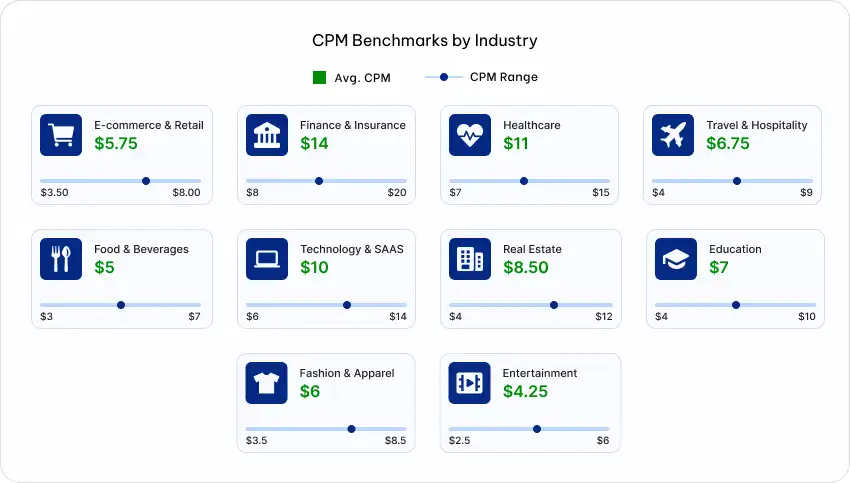
| According to industry benchmarks, the finance sector has the highest average CPM, with businesses paying approximately $14.00 per thousand impressions. Source: cpmcalculator. |
Formula for Calculating CPM in Advertising

Advertisers need to understand the formula that helps them calculate their overall CPM and determine if they are profiting or simply wasting their advertising budget.
Figuring out CPM isn’t complicated at all. It comes down to one simple formula that tells you exactly what you’re paying every time your ad gets shown a thousand times.
Here is a formula for calculating CPM in digital advertising, along with an example.
Formula: CPM = (Total Cost ÷ Total Impressions) × 1,000
Let’s take an example of how advertisers can calculate the CPM of an ad campaign.
Say an advertiser spends $500 on an ad campaign that generates 250,000 impressions.
CPM = ($500 ÷ 250,000) × 1,000 = $2
That means the advertiser is paying $2 for every 1,000 times their ad is shown.
The average Cost-Per-Mille for the Google Display Network is $3.12, while Facebook Ads have an average CPM of $8.60. Source: dashthis
Why do Advertisers Use CPM?
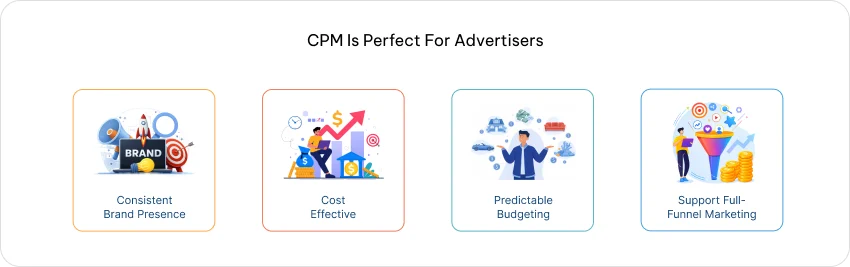
CPM has stuck around for decades because it solves a real problem: how do you compare ad impression costs across wildly different platforms and formats? Whether you are running display ads or video pre-rolls, CPM gives everyone a common yardstick. Here’s why advertisers keep coming back to it:
- Maintain a Consistent Brand Presence: CPM ads keep your brand visible across a website or other digital platforms, helping your business stay top of mind even when users aren’t ready to make a purchase.
- Cost-Effective for Visibility: Since you pay for impressions rather than for clicks or conversions, CPM in advertising is often a cost-effective way to increase brand awareness.
- Predictable Budgeting: CPM is a fixed rate, since advertisers pay for every thousand impressions regardless of user engagement. This simplifies planning and budget allocation for ad campaigns.
- Support Full-Funnel Marketing: CPM works well at the awareness stage of the customer journey, creating familiarity with a brand before retargeting users later with CPC or CPA campaigns that have the potential to drive clicks and conversions.
Want Lower CPM & Higher ROI?
Launch Smarter Campaigns with 7SearchPPC
Transparent Pricing | Verified Traffic Sources | Dedicated Account Support
When is CPM the Right Choice for Advertisers?
CPM isn’t the right fit for every campaign, but there are specific situations where it clearly makes the most sense. Knowing when to use it can save you money and help you get better results from your ad spend.
Here’s when CPM in advertising works best:
1. When Brand Awareness Matters More Than Sales
Brand awareness is the first step, not an afterthought. Promoting a product directly to a cold audience often results in low conversions, as people don’t buy from brands they don’t recognize or trust.
This is where CPM campaigns come in. Instead of pushing for immediate sales, CPM focuses on visibility as it helps get your brand in front of the right audience, making them far more likely to convert when you do run a sales campaign.
2. When Testing the Performance of Ad Creative
When you’re testing how well a new ad creative performs, CPA or CPC isn’t the ideal metric to rely on. Both are heavily influenced by external factors, such as landing page quality and audience intent, making it harder to know how the ad creative is truly resonating with viewers.
CPM focuses on the single most important factor at this stage: exposure cost. You’re paying per thousand impressions regardless of clicks or conversions, making it a cost-effective way to test which ad creative captures attention most efficiently.
3. When the Advertiser Already Has a High-Converting Landing Page
CPM isn’t just for advertisers who want brand recognition; it’s also beneficial for those who ultimately care about conversions, as long as their creatives and landing pages already convert well organically.
If an advertiser knows that a solid percentage of people who see their ad will act, whether by remembering the brand and searching for it later or engaging with a strong call-to-action within the ad itself, then buying cheap impressions in bulk at CPM can yield a lower overall cost-per-conversion.
In short, if you trust your funnel, CPM can outperform CPC. You are betting on your own brand strength rather than paying extra for clicks.
4. When CPC Becomes Too Expensive for Your Industry
When advertising in highly competitive industries such as technology, e-commerce, real estate, or financial services, CPCs on auction-based platforms like Google or Meta can be extremely high due to heavy bidding.
For advertisers in these categories who want visibility, shifting toward CPM-based display or video placements can be significantly more economical for achieving reach.
Source: CPM Calculator
CPM vs. Other Digital Advertising Pricing Models
CPM is not the only pricing model; there are many other models available in the digital ecosystem. Let’s examine some well-known pricing models and understand what each one offers.
1. Cost Per Click (CPC)
It’s a pricing model in which advertisers pay only when someone clicks their ad. Unlike cost per mille, where pay is based on the number of impressions, CPC focuses more on engaging traffic to view the offers rather than just awareness.
CPC vs CPM: Here’s How They Actually Differ
CPC | CPM |
Payment is made only when a user clicks the ad. | Payment is based on every 1,000 impressions on the ad. |
| Better suited for campaigns with measurable actions, such as sales or lead generation. | Better suited for campaigns aimed at building brand recognition and recall. |
| Typically used for search ads and performance-driven campaigns. | Commonly used for display, video, and awareness campaigns. |
2. Cost Per Action (CPA)
Cost per action or cost per acquisition is a digital pricing model in which advertisers pay only when a user completes a specific desired action, such as signing up, making a purchase, or submitting an application. CPA focuses on actual conversions rather than awareness.
CPA vs CPM: Here’s How They Actually Differ
CPA | CPM |
| Lower financial risk because payment is based on successful conversions. | Higher risk because impressions do not guarantee clicks or conversions. |
| Requires accurate conversion tracking to measure campaign performance. | Requires impression tracking to measure ad reach and exposure. |
| Generally has a higher cost per conversion but better ROI. | Generally has a lower cost per impression but does not guarantee engagement or sales. |
Key Considerations Across All Three Pricing Models for Advertiser Clarity:
- Prefer Cost Per Mille (CPM) when your priority is brand awareness and maximum reach.
- Prefer Cost Per Click (CPC) when your goal is to drive traffic and encourage people’s engagement.
- Prefer Cost Per Action (CPA) when your focus is conversions, leads, or sales, and you want to pay only for completed actions.
What’s Considered a Good CPM for Advertisers?
Determining what constitutes a “good” CPM depends on several factors, including your campaign objective, industry, target audience, and, perhaps most importantly, the advertising network or platform you’re using. Ultimately, whether a CPM is good comes down to whether it helps you achieve your specific goals.
For example, suppose you’re in the finance industry and have set a $2 CPM as your target. If you secure a deal at $1.5 CPM, that would be considered a good CPM in advertising, since it comes in under budget while still meeting your campaign objectives.
On the other hand, if you spend $4 CPM and fail to achieve the results you were aiming for, that CPM would be considered unfavorable regardless of how it compares to industry benchmarks.
This example illustrates a key point: a “good” or “bad” CPM isn’t an absolute figure. It’s entirely relative to your campaign objectives and the return you’re getting from your investment.
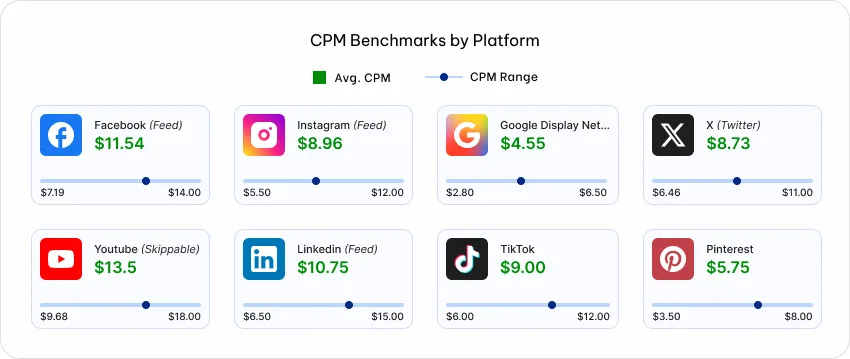
Note: CPM rates differ widely by platform and are shaped by many factors. The figures provided here are meant as rough planning benchmarks, not a guarantee that any specific campaign will actually achieve those rates when it runs.
Which Factors Affect CPM in Advertising?
CPM advertising rates are generally lower than those in other pricing models, as advertisers choosing CPM want to spend less while still achieving effective results. However, CPM isn’t fixed; it can spike suddenly based on market conditions, so knowing what drives it up helps you budget more accurately.
Below are the key factors that affect CPM:
1. Seasonality and Demand
Since childhood, you have probably heard someone say, “Don’t buy those mangoes now, they are too expensive. Wait until they are in season!” or “Everyone wants this product right now, so the price has shot up. Let’s wait for demand to cool down.”
The same principle applies to pricing models like CPM. Price increases aren’t random; they are heavily influenced by seasonality and demand.
During peak shopping seasons or major events such as Black Friday, Cyber Monday, and Christmas, more advertisers compete for the same ad inventory. This increases competition and drives up the cost per thousand impressions.
2. Selecting the Wrong Ad Platform
One of the factors that affects CPM the most is choosing an advertising platform that is ineffective at delivering outcomes and offers higher CPM rates than others. Each platform has its own CPM costs based on audience demand and competition.
When you advertise on a platform that isn’t a good fit for your target audience, your ads compete in more expensive auction pools and generate lower engagement. As a result, the platform’s algorithm reduces your ad efficiency, leading to higher CPMs.
3. Creative Efforts and Ad Formats
Running the same ad creative repeatedly and selecting an ad format with a high CPM can significantly impact an advertiser. CPM increases when you show the same ad creative to the same audience multiple times, as it raises the risk of ad fatigue and causes people to ignore your ads.
Lower engagement signals to the platform that your ad is less effective, potentially leading to higher CPMs over time. The ad format also plays an important role, as some formats are more competitive and therefore naturally have higher CPMs.
4. Ad Placement Competition Across Industries and Niches
The level of competition in your industry is another major factor that affects CPM rates. Businesses operating in highly competitive industries such as insurance, real estate, or legal services often experience higher CPMs because more advertisers are competing for the same audience and ad placements.
If you’re advertising in a competitive niche using the CPM pricing model, expect your CPM to be higher than in less competitive industries.
How Advertisers Can Reduce CPM Costs
Every advertiser aims to lower CPM while maintaining strong campaign performance. Reducing CPM not only helps optimize your advertising budget but also improves the overall ROI.
Here are some effective ways to reduce CPM in online advertising:
1. Increase Ad Relevance
Ad relevance is one of the best ways to reduce your CPM. It’s basically a measure of how well your ads match your audience’s actual interests, needs, and expectations. Advertising platforms like Google care deeply about this because relevant ads improve the user experience.
So when people respond well to your ad, the platform takes notice and usually pays you back with a lower CPM.
Ways to improve ad relevance
- Focus on writing compelling headlines that immediately address customer needs.
- Use high-quality images and videos.
- Highlight a clear value proposition.
2. Test Different Ad Formats
If you rely on a single ad format, you will never know that there are other formats you can use to lower your CPM. Online advertising platforms offer various ad formats, each with different advantages. Testing multiple formats allows advertisers to identify which option helps reduce CPM.
For example, consider a banner CPM ad campaign running at $0.09 CPM. By testing an alternative ad format, such as an in-page push ad, you discover that it reaches your target audience more cost-effectively, achieving a CPM as low as $0.02.
Ways to test ad formats effectively
- Run A/B tests across multiple ad formats with the same targeting and budget to fairly compare performance.
- Prioritize video content where possible, since it often drives higher engagement and watch time on most platforms.
3. Improve Audience Targeting
While accurate audience targeting can boost engagement, going too narrow can raise costs since you end up paying more for a smaller reach. The key is finding the right balance to refine your audience targeting while keeping the CPM lower.
Ways to refine audience targeting effectively
- Utilize layered targeting (interests, behaviors, demographics) where you don’t rely on a single criterion, so you narrow down efficiently without restricting reach.
- Regularly review targeting performance and remove segments with low engagement or high costs.
4. Go for Ad Scheduling
It’s important for every advertiser to know that not all hours of the day perform equally. CPM in advertising fluctuates based on advertiser competition, and bidding for impressions during peak hours drives up your advertising costs.
Take time to figure out when your audience is actually most active, and you can adjust your ad scheduling to work in your favor. That means you can avoid paying during moments when competition is high and capture cheaper inventory during off-peak periods.
Ways to optimize ad scheduling effectively
- Review performance data by hour and day of the week to identify when CPM is lowest while engagement remains strong.
- Test shifting a portion of your budget to underutilized time slots (e.g., late night or early morning) where competition is thinner, and CPMs are naturally lower.
Advantages and Disadvantages of CPM
Like any pricing model, you have now learned that CPM has strengths that make it ideal for certain campaigns. However, it comes with its own set of trade-offs.
Below, we explore the pros and cons of CPM for advertisers.
Advantages of CPM | Disadvantages of CPM |
| Builds brand awareness easily and is ideal for visibility-focused campaigns. | No guarantee of engagement, you pay even if no one notices or clicks on your ads. |
| Predictable, easy-to-budget costs (fixed price per 1,000 impressions) | Ad fraud and bot traffic are major issues that inflate impression counts. |
| Easy to use and forecast across platforms. | Impressions can be counted even if the ad is not actually seen. |
| Provides access to premium, brand-safe inventory when selecting the right CPM ad network for advertisers. | Risk of ad fatigue/banner blindness from repeated impressions |
| Perfect for split testing creative without performance pressure. | Harder to justify for performance-focused campaigns (leads, purchases, sign-ups) |
Ultimately, CPM in advertising is an excellent choice for maximizing brand visibility and reach, but businesses focused on actions like clicks, leads, or conversions should evaluate a performance-based pricing model that better aligns with their goals.
eCPM vs CPM: What’s the Difference?
If you’re new to advertising, you’ve probably already come across CPM. But once you start digging deeper, you’ll likely run into another term: eCPM. While the two sound similar and are closely related, they measure different things, and understanding makes things clear for you.
Here is how eCPM differs from the CPM:
eCPM (Effective Cost Per Mille), on the other hand, is a performance metric rather than a pricing model. It calculates the actual revenue generated per 1,000 impressions.
In simple terms:
- CPM tells you what you’re paying (from the advertiser’s perspective).
- eCPM tells you what you’re actually earning (from the publisher’s perspective).
Maximize Visibility Without Stretching Your Budget
Brand awareness starts with consistent visibility. 7SearchPPC enables advertisers to run CPM campaigns that deliver a broad audience reach while maintaining cost efficiency.
Whether you are promoting a new product or expanding into new markets, 7SearchPPC lets you achieve better exposure. Take the next step, schedule a meeting today, and expand your brand’s reach with 7SearchPPC.
Frequently Asked Questions (FAQs)
Q1. What is CPM in digital marketing?
In digital marketing, CPM is a pricing model where advertisers pay only when their ads are viewed 1000 times. It charges advertisers for impressions and helps brands increase awareness.
Q2. How do you reduce CPM?
To lower CPM in advertising, advertisers need to focus on engaging the audience, as higher engagement often results in lower CPMs because ad platforms reward high-performing ads.
Q3. How does layered targeting help lower CPM?
Layered targeting combines different audience attributes like demographics, interests, behavior, and location to reach people most likely to convert. This approach enhances ad relevance while preventing audiences from being too narrow. This helps lower CPM over time.
Q4. What is a good CPM in advertising?
A good CPM depends on industry, platform, objective, target audience, and competition. Instead of a universal benchmark, assess if your CPM helps reach your goals. If your campaign meets objectives at or below your target CPM, it’s a good CPM.
Q5. What is CPM in social media?
CPM in social media refers to the amount advertisers pay for every 1,000 impressions their ads receive on platforms such as Facebook, Instagram, LinkedIn, TikTok, and X.
Q6. How to calculate CPM in advertising?
When advertising, it’s easy to calculate the cost per mille (CPM). Use this formula:
CPM = (Total Advertising Cost ÷ Total Impressions) × 1,000